Shaping Christian Faith
From the Apologists to Justinian
Gunnar af Hällström
Translated by Demos Kouvidis
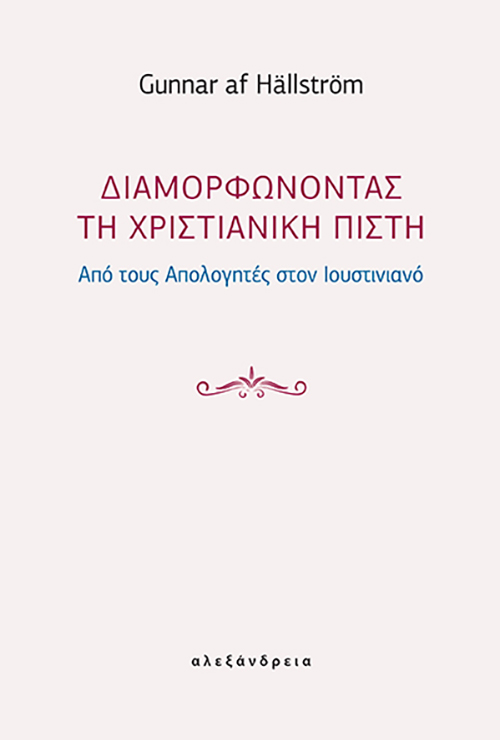
Publisher: Εκδόσεις Αλεξάνδρεια, 2026
Softcover: 240 pages
Language: Greek
ISBN: 978-618-223-120-3
:: Buy from Αλεξάνδρεια ::
Summary (english translation)
A variety of theological and historical articles (the fruit of 40 years of research, published in Greek for the first time), covering the early centuries crucial to the formation of Christian doctrine, from the early Apologists (2nd century) and Origen to Justinian’s closure of the Neoplatonic Academy of Athens in 529 AD.
What were Justinian’s motives when he closed the Neoplatonic School (as well as the Law School) of Athens in 529 AD? How does a recent convert, starting, according to Origen, from an “irrational impulse”, choose to embrace Christian doctrine, and how does he perfect his faith by combining it with the proper liturgical practice and an exemplary life of “good works”? What did the Apologists mean by the term Providence/Providentia, which they introduced from Greco-Roman religion? How did they differentiate it and assign it a dominant place in their subsequent theology? How did the emperor Justinian come to regard himself as the embodiment of Divine providence? How was the biblical canon formed, and what “beneficial” books were Christians permitted to read beyond the “divinely inspired” sacred scriptures? How is Plato’s Symposium related to Methodius’s Symposium of the Ten Virgins? What is divine wrath, and how is it reconciled with divine philanthropy? Do human beings act in the image of God when they become angry or fall into mortal sin?
These are some of the questions addressed by the theological and historical articles in this volume, the harvest of forty years of thorough research and study of the sources. These are issues that marked four critical centuries (2nd-6th centuries), during which the religion in the process of formation –individual Christian thinkers and believers as well as local churches and Ecumenical Councils, with the Apologists, Origen, and Justinian as figures of reference– struggled to define and highlight a distinct doctrinal identity, at times incorporating and at times rejecting elements of competing religions and “heresies”, until its universal message became established in East and West.